

If overly large breasts are causing back, neck, or shoulder pain, limiting your activity, or making it difficult to find clothes that fit comfortably, breast reduction surgery may provide relief. The procedure is most often performed by a plastic surgeon, but not every doctor who uses the term “cosmetic surgeon” has the same training or experience.
Finding the right provider means evaluating credentials, breast surgery experience, facility safety, communication, and insurance support. This guide will explain who performs breast reduction surgery, how to find a breast reduction surgeon with the right qualifications, and how to approach your consultation.
Who Performs Breast Reduction Surgery?
More than one type of physician may perform breast procedures, but their training can vary significantly. For most patients, the best place to begin is with a plastic surgeon certified by the American Board of Plastic Surgery (ABPS) who has extensive experience performing breast reductions.
According to the ABPS, certification confirms that a surgeon has completed the appropriate plastic surgery training and passed comprehensive written and oral examinations. The standard training path includes at least six years of surgical training after medical school, including at least three years focused specifically on plastic surgery. The American Society of Plastic Surgeons also recommends choosing a board-certified plastic surgeon who operates in an accredited, state-licensed, or Medicare-certified facility.
| Surgeon type | Training and credentials to verify | Breast reduction experience |
| ABPS-certified plastic surgeon | Plastic surgery training and ABPS certification | Usually the strongest match for cosmetic or medically necessary breast reduction |
| Cosmetic surgeon | Exact residency, fellowship, and certifying board | Depends on the surgeon’s actual surgical training |
| General surgeon | General surgery residency and current license | May have less specialized breast reduction experience |
| Gynecologist | OB/GYN residency and current license | Not typically trained as a breast reduction specialist or recommended for the procedure |
The title “cosmetic surgeon” by itself does not tell you how a physician was trained. Before scheduling surgery, verify the surgeon’s certifying board, residency, current medical license, and experience with breast reduction specifically.
What Should You Look for in a Breast Reduction Surgeon?
When it comes to something as important as breast surgery, you don’t want to settle for the first provider you can meet with or the surgeon closest to your home. But how do you find a surgeon who will go above and beyond to make sure your breast reduction is a success? Here are some of the factors that set exceptional surgeons apart from the rest:
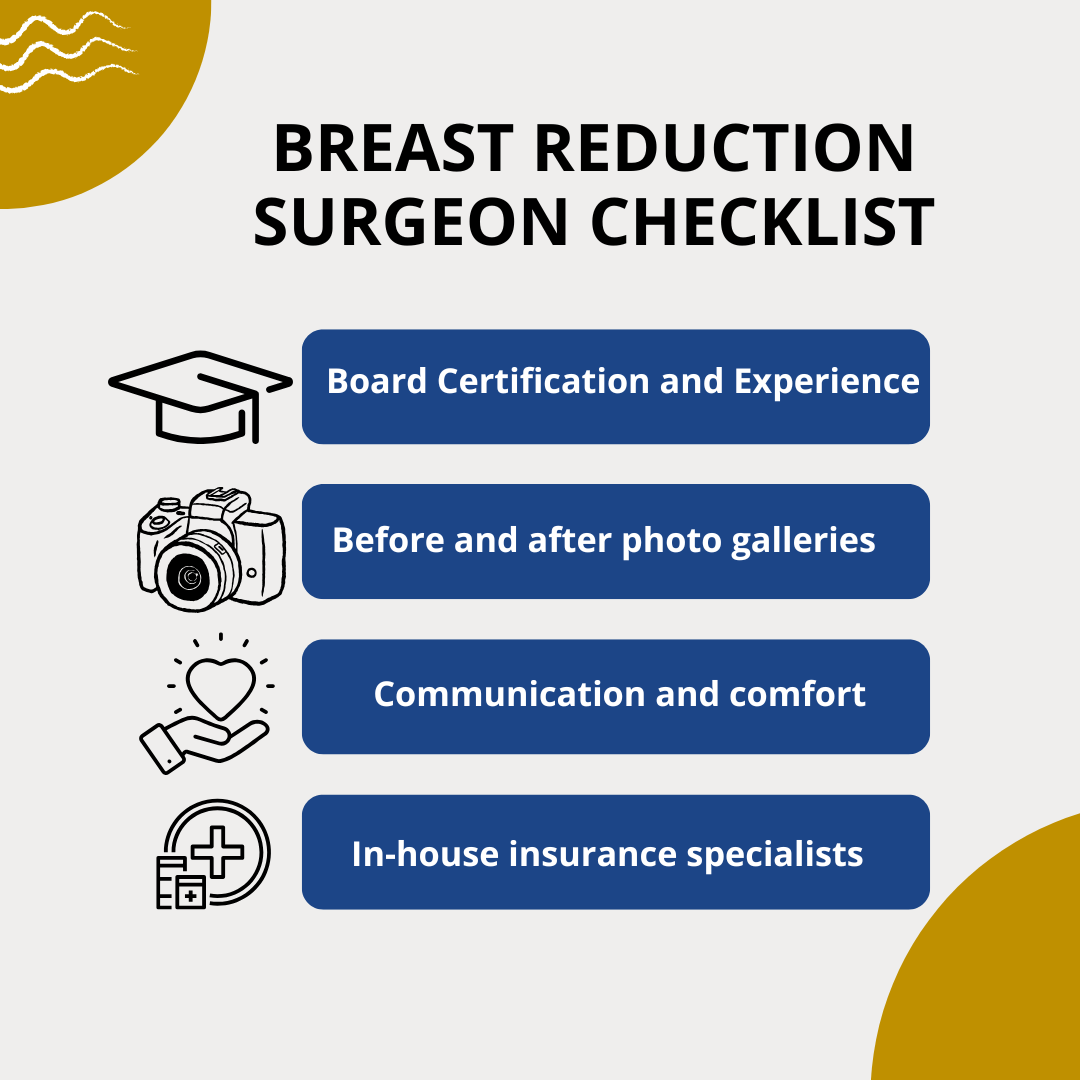
Board Certification
We can’t stress this enough: Make sure you confirm that the surgeon is ABPS-certified. This certification means the surgeon has completed extensive training and passed rigorous exams. The ABPS has a simple tool you can use to verify your surgeon’s certification online.
Experience with Breast Reductions and Advanced Surgical Techniques
Ask how many breast reductions they perform annually. Look for a surgeon with a significant portion of their practice dedicated to breast procedures (not just occasional cases). Top breast reduction surgeons offer multiple surgical approaches:
- Vertical (“lollipop”) technique: Minimal scarring for smaller reductions
- Traditional (“anchor”) technique: Comprehensive approach for larger reductions
- Advanced tissue preservation methods to maintain nipple sensation
Different approaches are used for different patients, and an expert surgeon knows which surgical techniques and incision methods will be best for your procedure.
Before and After Photos
Reviewing real patient results can give you a sense of the surgeon’s aesthetic style and consistency. Make sure the surgeon has before and after photos of past patients on their website.
Communication and Comfort
You should feel comfortable asking questions and confident that the surgeon understands your goals. A good surgeon will be transparent about what’s possible, the risks involved, and your expected recovery.
Hospital Affiliations
Quality surgeons maintain privileges at accredited hospitals. In fact, it is a red flag to use a surgeon with an office-based operating room that has no hospital privileges to do the procedure they are offering in their office facility. A plastic surgeon with hospital affiliations is a green flag, as it signals the peer recognition that comes with proven expertise and safety records.
Experience with Insurance Coverage
Many breast reductions are medically necessary and covered by insurance. However, securing that coverage can be complicated, as it requires evidence of physical symptoms, non-invasive treatment efforts, and more.
Working with an expert surgeon and care coordinator gives you the best chance of securing insurance coverage for your procedure. They work closely with insurance providers and know how to maximize your benefits to keep your out-of-pocket costs as low as possible.
Do You Need to Choose an In-Network Plastic Surgeon?
Many women considering breast reduction surgery believe they need to choose an in-network plastic surgeon in order to utilize their insurance coverage. However, this isn’t the case. Many insurance plans include out-of-network benefits, which gives you the freedom to choose an out-of-network surgeon while still reducing the overall cost of the procedure.
Plus, the No Surprises Act, introduced in 2022, provides significant protections for patients who choose to receive care from an out-of-network provider. Through the act, patients are only responsible for their in-network cost-sharing amounts (deductibles, copays, coinsurance), while the health plan pays the rest to the out-of-network provider.
What Happens During a Breast Reduction Consultation?
During your consultation, the surgeon should review your health history, listen to your symptoms and goals, examine your anatomy, and explain the surgical options available to you. You should also receive a realistic overview of recovery, risks, costs, and next steps.
Before your appointment, think about what you hope surgery will accomplish. Do you want relief from back or shoulder pain, fewer rashes, greater freedom during exercise, or a smaller and more balanced breast size? The more clearly you explain your priorities, the easier it will be for your surgeon to create a plan that reflects your needs.
What Breast Reduction Care Looks Like at Harris Plastic Surgery
At Harris Plastic Surgery, Dr. Stephen U. Harris, MD, FACS, is board-certified by the American Board of Plastic Surgery and has over 30 years of breast-specific surgical experience. He has performed thousands of breast procedures, serves as Chief of Plastic Surgery at Good Samaritan Hospital in West Islip, New York, and is an active staff surgeon at South Shore University Hospital.
The practice also helps patients manage the insurance and administrative side of medically necessary breast reduction. Joanne Parrinello, the practice manager, has two decades of experience helping patients understand insurance requirements and expected costs. The practice can coordinate with your insurance provider on your behalf, which means you can focus on learning about and preparing for the procedure itself.
How to Find a Breast Reduction Surgeon You Can Trust
Knowing how to find a breast reduction surgeon can make the process feel much more manageable. Start by verifying board certification, reviewing breast reduction experience, and scheduling a consultation where you feel heard and well-informed.
If you are ready to discuss your goals, surgical options, and insurance coverage, schedule a breast reduction consultation with Harris Plastic Surgery.

Stephen U. Harris
| MD FACS
Dr. Stephen U. Harris is a board-certified plastic surgeon and a recognized expert in breast reduction and reconstruction surgeries, having performed thousands of these procedures in his career. When it comes to patient care, his philosophy is that every surgery should improve his patients' overall quality of life, not just their appearance. Dr. Harris stays up-to-date on all the latest advancements in breast augmentation, reconstruction, and reduction and is a recognized innovator in the field. In fact, he was the first surgeon at Good Samaritan Hospital to offer primary prepectoral implant breast reconstruction, as well as secondary prepectoral revision surgery.
Dr. Harris also serves as Chief of Plastic Surgery at Good Samaritan Hospital in West Islip, New York, and is an active staff surgeon (and former Chief of Plastic Surgery) at South Shore University Hospital in Bay Shore, New York.