

This guide offers a snapshot of the trends in breast reduction surgery (reduction mammoplasty) in the United States. We’ve included statistics on procedure volume trends, patient demographics, surgical technique preferences, insurance coverage rates, and out-of-pocket costs to provide a comprehensive view of the current breast reduction landscape.
Breast Reduction Surgery Volume Trends: 2022-2024
Let’s start with the big picture: how many breast reduction surgeries are being performed in the United States, and how has that number changed over the past three years?
|
Breast Reduction Surgery Trends U.S., 2022 to 2024 |
||||
|---|---|---|---|---|
|
Year |
Breast reduction in men (Gynecomastia) |
Breast reduction in women (reduction mammoplasty) |
Total procedures |
% change from prior year (total procedures) |
|
24,753 |
43,591 |
68,344 |
— |
|
|
20,955 |
46,340 |
67,295 |
-1.53% |
|
|
18,575 |
33,574 |
52,149 |
-22.5% |
|
|
24,517 |
71,364 |
95,881 |
+83.9% |
|
|
25,888 |
76,031 |
101,919 |
+6.3% |
|
|
26,430 |
76,734 |
103,164 |
+1.2% |
|
The data above is sourced from the American Society of Plastic Surgeons, and includes only breast reduction surgeries performed by ASPS-certified members. The numbers indicate that both male and female breast reduction procedures have risen sharply in recent years, rebounding well beyond pre-2020 levels and showing steady interest year over year. Here’s what the data really tells us.
In 2020, total breast reduction procedures dropped to 52,149, reflecting the predictable pandemic-related decline seen across nearly every elective surgery category. But what’s remarkable is just how strongly the field rebounded. By 2022, procedure volume climbed to 95,881, an 83.9% increase from 2020. The growth continued into 2023, rising another 6.3%.
This aligns with national trends reported by ASPS and other surgical databases, which highlight:
- Growing awareness of the procedure’s medical benefits
- Expanded insurance coverage for medically necessary cases
- Surgeons reporting larger numbers of patients seeking relief from back, neck, and shoulder pain, particularly among those working remotely or spending more time sitting
After the huge jump in 2022 and the strong rise in 2023, the 2024 growth rate slowed to 1.2%. This leveling suggests that breast reduction volume is no longer surging, but it has settled into a much higher baseline than before 2020.
Gender Distribution Trends in Breast Reduction Surgery
While breast reduction is predominantly sought by women, male breast reduction (gynecomastia surgery) represents a meaningful segment of the market. Gynecomastia surgery grew at more than double the rate of female breast reduction (+2.1% vs. +0.9%), indicating an increasing demand for this procedure.
This could be due to:
- Increased cultural awareness around gynecomastia
- More open conversations about male body contouring
- Weight fluctuations related to lifestyle changes and GLP-1 medications
- Greater social acceptance of male cosmetic surgery overall
Notably, men consistently make up about 25–27% of all breast reduction procedures in recent years, higher than many people realize.
Who’s Getting Breast Reduction Surgery? An Age Breakdown
Understanding who seeks breast reduction surgery helps paint a picture of the typical patient. Here’s how breast reduction procedures are distributed across age groups in 2024:
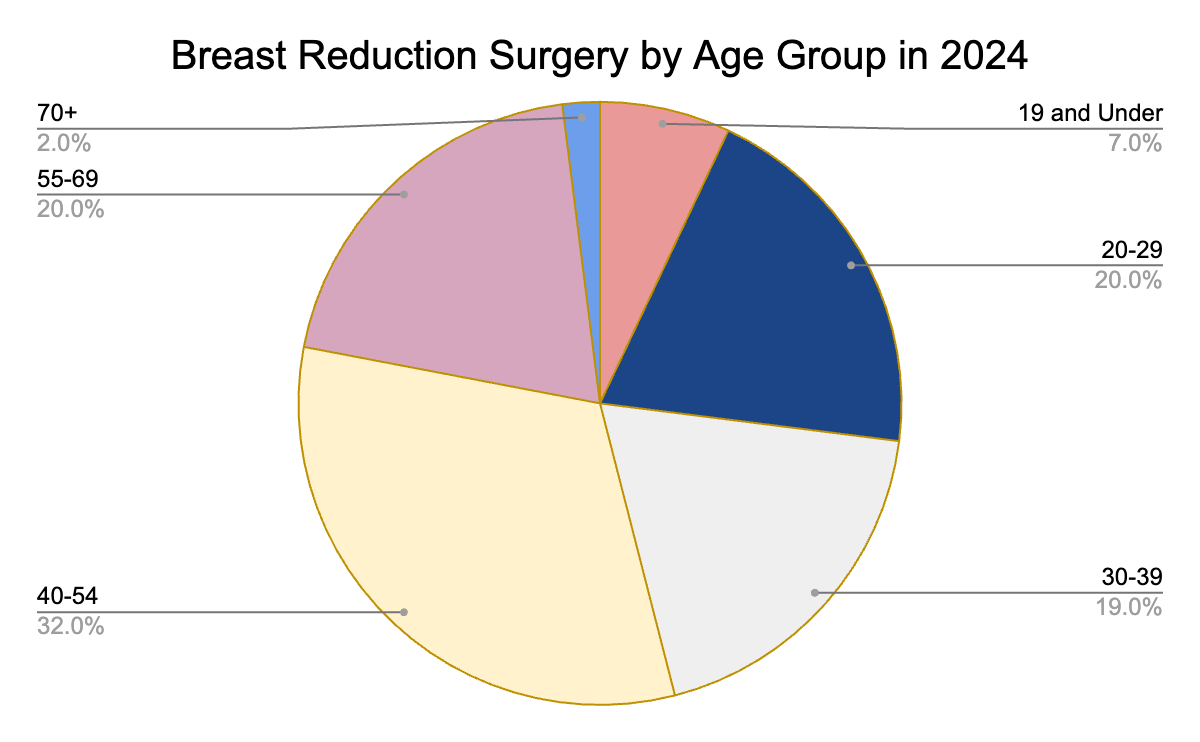
Patients aged 40-54 represent nearly one-third (32%) of all breast reduction surgeries, making this the most common age group for the procedure. One in five procedures (20%) is performed on patients in their twenties, suggesting that younger individuals are more willing to pursue surgical solutions for physical discomfort earlier in life.
Teen procedures also remain significant, with 7% of breast reduction surgeries performed on patients 19 and under. These are primarily for cases of macromastia causing significant physical or psychological distress that meets medical necessity criteria.
Most Common Breast Reduction Techniques and Incision Types
Surgeons use several different incision patterns for breast reduction surgery, each with distinct advantages. The choice often depends on the amount of tissue to be removed and the patient’s anatomy.
|
Breast Reduction Incision Types by Popularity |
||
|---|---|---|
|
Technique |
Contemporary trend / percent (surveyed surgeons) |
When it’s used |
|
Inferior/central pedicle (anchor) with T (Wise) scar |
Historically and currently the most popular choice in North America; most common when larger amounts of tissue are being removed |
|
|
Vertical (lollipop) reductions |
Favored when wanting less scarring but not always suitable for very large resections |
|
|
Liposuction only |
A small subset of patients are candidates for scarless breast reduction using liposuction, which removes only fat |
|
The traditional “anchor” incision continues to be the gold standard approach, particularly for patients requiring significant tissue removal and reshaping. Surgeons generally prefer this method because it offers the highest level of control when the goal is to remove a large amount of tissue and reshape the breast in a predictable way.
The vertical or “lollipop” incision method has grown in popularity, often favored for patients needing moderate reduction with less scarring along the breast crease. This method can be limiting when a large amount of skin or glandular tissue must be removed. Without the horizontal incision, surgeons have less ability to control breast size, address excess lateral tissue, or prevent bottoming-out over time.
Liposuction-only reduction accounts for less than 5% of cases nationwide. Although it offers the shortest scars, and in some cases, virtually no noticeable incisions, it is only appropriate for a very select group of patients. Liposuction can remove fat, but it cannot lift the breast, tighten excess skin, or reshape the lower pole. It’s unlikely that it will grow in popularity or replace traditional breast reduction techniques in any way.
Insurance Coverage and Cost of Breast Reduction Surgery in 2025
One of the most common questions patients have is whether insurance will cover breast reduction surgery. The data reveals significant variation in coverage approval rates:
|
Insurance Coverage Status for Breast Reduction |
||
|---|---|---|
|
Coverage Type |
% of Procedures |
Average Patient Out-of-Pocket Cost |
|
Fully Covered by Insurance |
28% |
|
|
Partially Covered (Co-insurance/Deductible) |
37% |
|
|
Denied/Patient Chose Not to Submit |
35% |
|
65% of breast reduction procedures involve insurance to some degree, with 28% being fully covered and 37% partially covered after patients meet deductibles and co-insurance requirements. While the average cost for patients without insurance is $9,002, this figure varies extensively, and costs can surpass $20,000 for some patients without insurance.
Trends in Breast Reduction Surgery Costs
As with many surgical procedures, the cost of breast reduction surgery has increased in recent years, in part due to inflation and the COVID-19 pandemic. Let’s take a look at the changes in breast reduction surgery costs since 2020:
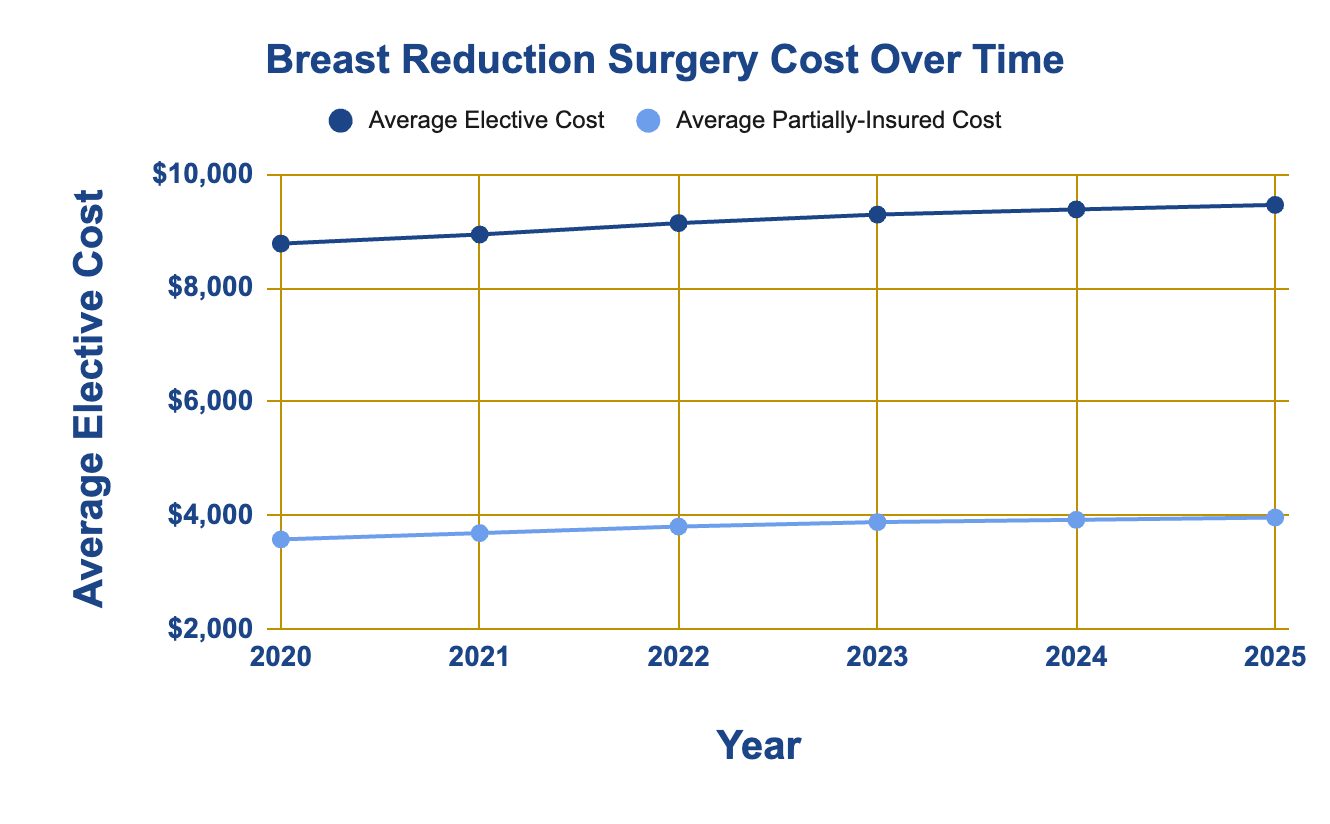
Fully out-of-pocket procedures rose from $8,780 in 2020 to $9,460 in 2025, an increase of roughly 7.7% over five years. This mirrors broader increases in healthcare costs driven by inflation, rising provider expenses, and higher demand for cosmetic breast reduction among patients seeking both functional and aesthetic outcomes.
Partially insured procedures follow a similar pattern, with much lower patient cost. For individuals with partial insurance coverage, out-of-pocket costs increased about 10.7% from 2020 to 2025. Despite the slightly faster percentage growth, insured patients consistently pay less than half of what elective patients pay. This reinforces the value of meeting medical-necessity criteria, as insurance significantly offsets total cost.
Both categories show annual increases of between $40 and $200, suggesting stable, incremental pricing rather than dramatic jumps. This stability helps patients plan ahead, especially those pursuing insurance approval, which can take several months.
Benefits Driving Breast Reduction Demand in 2025
Patients pursue breast reduction surgery for a variety of physical and emotional reasons. Here’s what patients most commonly report as their primary motivation:
- Chronic back, neck, or shoulder pain
- Difficulty exercising or physical activity limitations
- Skin irritation or rashes under breasts
- Emotional/psychological discomfort
- Difficulty finding clothing that fits
- Posture problems
According to data from Blue Shield, shoulder, neck, or back pain are the most common stated medical rationale for breast reduction procedures.
Average Tissue Removal Data Trends
One of the most common questions patients ask is how much tissue will be removed and how many cup sizes they’ll reduce. Currently, most insurance companies require removal of at least 200 grams per breast to consider the procedure medically necessary, but it depends on factors like BMI and the Schnaur Scale.
