
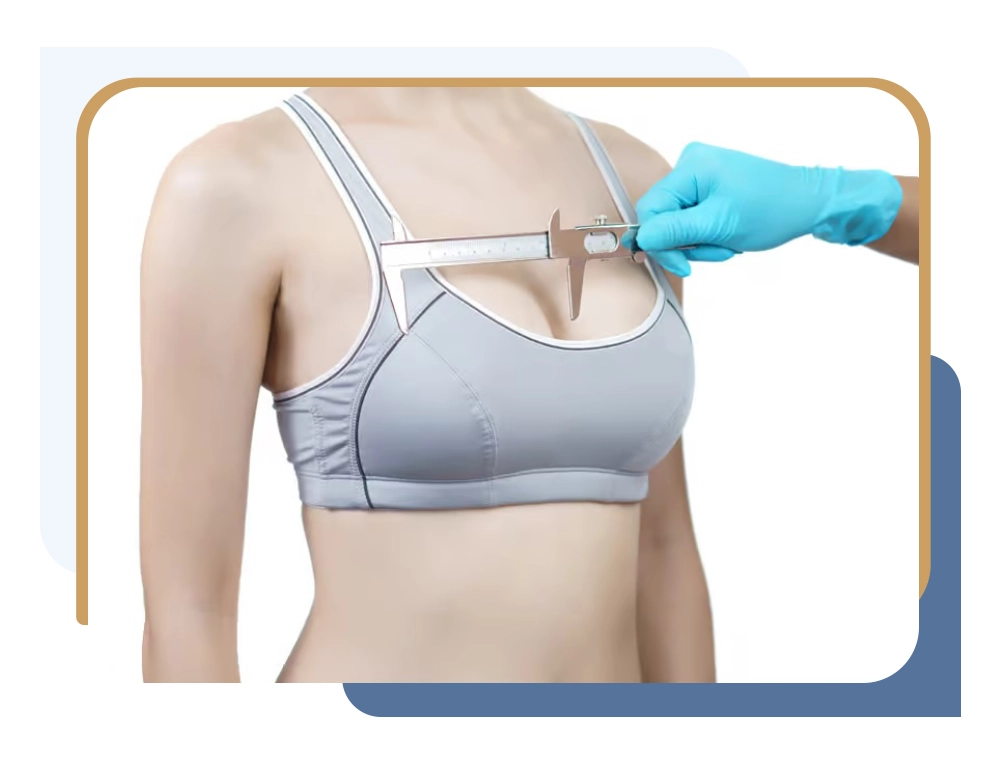
The Schnur Scale is a breast reduction size chart that surgeons use to estimate the amount of breast tissue that should be removed during breast reduction surgery. It’s used to assess whether surgery is considered medically necessary vs purely cosmetic.
This scale matters because it is what insurance companies use to determine whether they will cover breast reduction surgery, based on whether it is medically necessary or not.
What Is the Schnur Scale for Breast Reduction?
Insurance companies consider breast reduction cases in one of two ways: whether the surgery is cosmetic or medically necessary. While cosmetic surgeries are not covered by insurance, those deemed medically necessary are.
The original Schnur Scale study found that all women who sought breast reduction surgery for medical reasons had a specific amount of breast tissue removed. When measured against their body surface area (BSA), the amount of tissue removed put them at least in the 22nd percentile on the scale.
So, the rule insurance companies use is that your tissue removal estimate must be at least in the 22nd percentile, based on your BSA. Here’s a breast reduction size chart explaining how that number translates:
| The Schnur Sliding Scale Breast Reduction Size Chart | |
| Body Surface Area (meters sq.) | Minimum tissue removed per breast (g) |
| 1.35 | 199 |
| 1.40 | 218 |
| 1.45 | 238 |
| 1.50 | 260 |
| 1.55 | 284 |
| 1.60 | 310 |
| 1.65 | 338 |
| 1.70 | 370 |
| 1.75 | 404 |
| 1.80 | 441 |
| 1.85 | 482 |
| 1.90 | 527 |
| 1.95 | 575 |
| 2.00 | 628 |
| 2.05 | 687 |
| 2.10 | 750 |
| 2.15 | 819 |
| 2.20 | 895 |
| 2.25 | 978 |
| 2.30 or greater | >= 1,000 |
If your doctor ends up removing less tissue than expected, insurance will still cover the surgery in most cases. As long as your surgeon makes a good-faith estimate that meets the insurance company’s criteria, your breast reduction surgery should be considered medically necessary.
How Much Tissue is Actually Being Removed?
To put the breast reduction size chart in perspective:
- 200-300 grams per breast = approximately one cup size reduction
- 400-500 grams per breast = approximately two cup sizes
- 600-800 grams per breast = approximately three or more cup sizes
- 1,000+ grams per breast = significant reduction, often multiple cup sizes
These are general estimates, as breast density, composition, and individual body proportions all affect the final result. The breast reduction size chart focuses on weight of tissue removed, not final bra size.
How to Use the Breast Reduction Size Chart
We’ve made it easy to calculate your BSA and how much tissue must be removed for your breast reduction to be considered medically necessary:
Breast Reduction Calculator Using the Schnur Scale
Minimum Tissue to Remove (grams per breast)
Body Surface Area (BSA)
Body Surface Area (BSA)
Tissue Grams Required for Removal
This will give you an estimate for the minimum amount of breast tissue (in grams) that would need to be removed from each breast to meet the 22nd percentile requirement for your body surface area. This gives you a starting point for conversations with both your surgeon and your insurance provider.
Keep in mind that this is an estimate, and Dr. Harris will make a more precise determination during your consultation based on a physical examination.
Beyond the Breast Reduction Size Chart: Medical Necessity Requirements
While the Schnur Scale is essential for insurance approval, it’s not the only criteria for medically necessary breast reduction surgery. Even if the chart shows you have more than enough tissue to qualify, the surgery won’t be covered unless you also have a qualifying medical condition.
Insurance policies commonly list these conditions as:
- Cervical or thoracic pain syndrome (neck and upper back pain)
- Submammary intertrigo (chronic rash or skin irritation under the breast fold)
- Thoracic outlet syndrome (numbness or tingling in the arms)
- Shoulder grooving from bra straps
- Postural changes due to breast weight
Many policies also state that the plastic surgeon must have a reasonable belief that the surgery will resolve the patient’s condition. That can only be done after a thorough physical examination, patient history, and medical records review.
Next Steps: Consulting With an Experienced Surgeon
Working with a practice that’s familiar with breast reduction surgeries and Schnur scale calculations for insurance coverage can give you the reassurance of understanding how you qualify. At Harris Plastic Surgery, we make sure you understand all the requirements necessary for your insurance to cover your breast reduction surgery, including:
- How the breast reduction size chart applies to your specific body measurements
- Whether your symptoms meet medical necessity criteria
- What documentation your insurance company requires
- How to navigate pre-authorization and potential appeals
- What your expected out-of-pocket costs will be
Bringing Patient Advocacy to Breast Reduction and Reconstruction
We’re experts at advocating for our patients and have helped thousands of women gain insurance approval for life-changing breast reduction surgery. Reach out to our office to schedule your consultation to learn more. You can also contact us by phone/text.
